The Difference Between a Finding and a Public Effect
An audit can establish that an instrument observed a specific condition. It cannot establish that a proposed correction was factually eligible, approved, delivered, present in a later public response, or responsible for a search or business outcome.
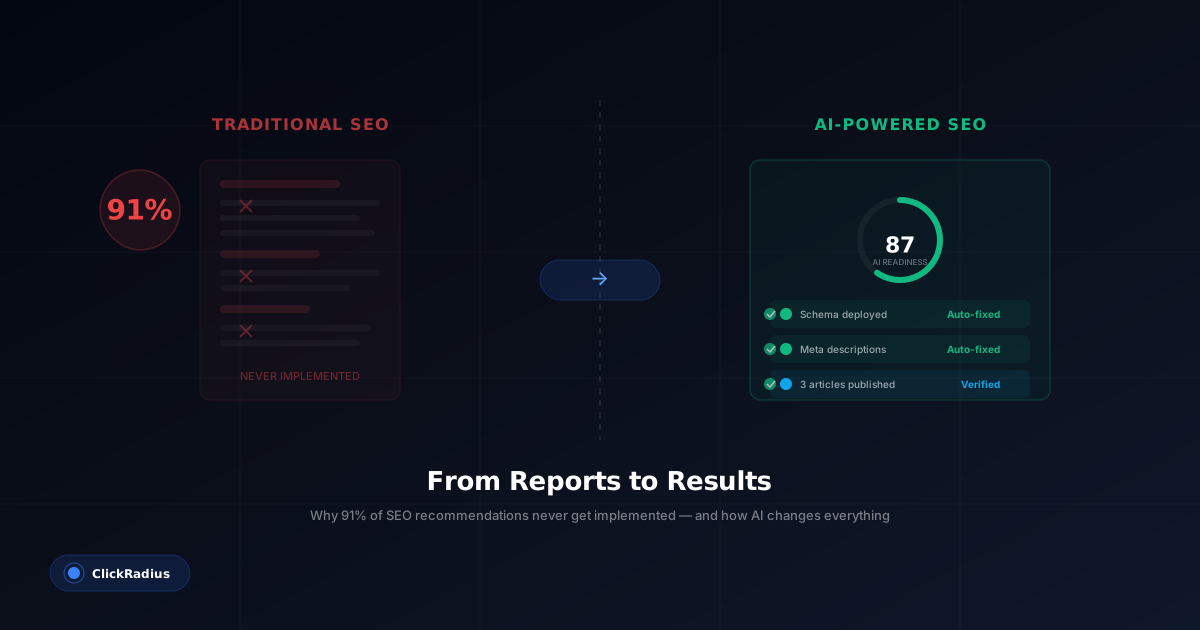
Implementation is the bottleneck, not diagnosis. Audit tools are good at finding problems; the work then waits on a developer, a ticket queue, or a planning meeting. ClickRadius does not publish an implementation-rate statistic, because we have no retained study that would support one.
This page does not publish an industry implementation rate or claim that most recommendations are technically sound; no retained study here supports either statement. It focuses on the state transitions a business can prove for its own work.
Five Operational Questions to Trace
These are review questions, not a universal explanation for every organization:
1. The Developer Queue
Does the proposed change require source-code, template, CMS, DNS, CDN, or provider access? If so, identify the exact effect and the connection that can perform it. A credential's presence is not proof of capability.
The wait between identifying an SEO fix and deploying it depends on a developer queue rather than on the audit, and for some enterprise clients critical schema issues sit in development queues for a long time. We do not publish an average, because we have no retained study that would support one.
2. Decision Evidence
Does the finding include the observed value, expected value, affected URL, source, risk, and limitation in language the approver can review? A severity label without that evidence is not an implementation decision.
3. Eligibility and Priority
Is the proposed revision supported by current facts and policy, and how was its order chosen? A readiness-family weight is an expert-set starting estimate, not an outcome-fitted impact projection. Factual risk, customer importance, dependency order, and reversibility may be better reasons to act first.
4. Delivery and Public Readback
Did the provider accept the exact authorized revision, and did an independent reread observe it at the intended public origin? A provider receipt is not the public result. A client-side JavaScript effect cannot be promoted to raw-origin verification.
5. Later Observation
Was the relevant surface measured again under a comparable protocol? A later difference can identify a regression or question to investigate, but timing alone does not prove the earlier revision caused it.
The operational goal is a traceable path from finding to exact revision, authority, provider receipt, public readback, and later measurement — with failed and unavailable states kept visible.
What This Means for AI Search
Generated answers add result surfaces that should be measured separately from conventional rankings. A response can contain prose, source links, cards, a map, multiple recommendations, or no business result; it is not a universal binary between “cited” and “invisible.”
Google's current guidance says its AI Overviews and AI Mode use ordinary Search eligibility and SEO foundations, with no special Schema.org markup required. Other providers expose different products and limited public documentation. The public response does not disclose a shared formula or prove which input caused a mention or citation.
Four Evidence Surfaces to Keep Separate
The implementation workflow can record these observable areas without claiming private provider weights:
- First-party pages. Record visible content, metadata, structured data, links, and technical access.
- Independent records. Inventory applicable profiles, directories, reviews, citations, and editorial references under their actual owners.
- Answer observations. Retain prompt, provider, response, source evidence, time, and coverage for each sample.
- Business outcomes. Attribute traffic, leads, revenue, cost, and margin only where record-level provenance supports the claim.
Where Automation Helps and Where Human Authority Remains
Automation can collect repeatable observations, prepare eligible candidate revisions, call a proven connector, retain receipts, and schedule another measurement. It cannot supply missing business facts, legal or policy judgment, client authority, provider control, or causal evidence.
Removing people from factual review and authorization would erase accountability rather than solve the workflow. The useful design makes each machine and human decision explicit.
This is what ClickRadius was built to support. Our patent-pending 5-engine architecture measures evidence, prepares eligible corrections, and monitors observed AI Presence on a monthly schedule. Applying a supported site effect requires current authorization and a capable connection; otherwise it remains for review or customer implementation. A provider receipt is recorded separately from an independent public-origin reread, and neither proves that an external engine observed the change. Here's what that workflow looks like in practice:
- Measure: The analyzer attempts to collect current evidence for the five AI Readiness families. Insufficient coverage remains unavailable rather than becoming a zero or a confident diagnosis.
- Prepare: Supported findings can produce a recommendation or exact proposed revision. The family weights are starting estimates, not weights fitted to customer outcomes, and no recommendation predicts a citation or business result.
- Authorize: The customer reviews the exact revision. A prior approval or general preference is not authority for changed bytes.
- Deliver: ClickRadius applies the authorized revision only through a connection that has demonstrated the capability required for that effect. Failure remains failure; provider acceptance is recorded as its own receipt.
- Verify: Where a public-origin reread is supported, ClickRadius records what the independent request observed. A provider receipt is not substituted for that observation.
- Observe monthly: AI Presence separately samples ChatGPT, Gemini, Perplexity, Claude, and Grok. A changed answer does not prove that the revision caused it, and Microsoft Copilot is not currently supported.
Completion time depends on the finding, review, authority, destination, connector capability, provider response, and reread availability. ClickRadius publishes no universal audit-to-effect timeline.
Why Establish a Measured Baseline Now
AI answer surfaces add a changing discovery surface that a business can measure. Starting now provides a dated baseline and more opportunities to compare later samples; it does not establish that competitors are absent or that an early citation will persist.
ClickRadius does not publish an early-mover cohort comparison because no retained cohort, method, or receipt supports one. The platform reports readiness evidence and dated answer observations as separate states. An observed sequence is not represented as reinforcement, persistence, or causation.
What "Acting Now" Actually Means
A defensible first pass is an evidence sequence, not a promised path to visibility:
- Establish a scoped baseline. Record the five AI Readiness families when coverage is sufficient, keep SEO Health separate, and retain the exact answer-observation protocol.
- Prioritize supported findings. Use factual risk, customer importance, dependencies, authority, and reversibility rather than an invented provider weight.
- Prepare and review the exact revision. Confirm every changed fact and protected byte before authorization.
- Measure the real effect. Keep provider receipt, public-origin reread, monthly AI Presence, and attributed business outcomes separate.
The question every business owner should ask is: can the current workflow implement authorized work and preserve a comparable monthly answer baseline, or will recommendations remain in a dashboard while the measured surfaces change?
A manual review or developer step can be the correct control. The defect is not human involvement; it is losing the exact decision, authority, effect, or evidence at a handoff.
ClickRadius brings scanning, prepared fixes and content, and monthly answer observations into one workflow. Applying an eligible site effect still requires current authorization and a connection proven capable of that exact effect; otherwise the work remains for review or customer implementation. Run a free AI Readiness Score to inspect the supported starting evidence.