Where a Diagnostic Workflow Stops
Many SEO tools focus on diagnosis: they crawl a site, identify issues and present findings for a person or team to implement.
The operational question comes next: what is eligible to change, who authorized it, which connector can perform it, and what evidence confirms delivery?
A diagnostic report and a live-site effect are different states. ClickRadius was designed to keep the finding, approved revision, provider receipt, independent public-origin reread and later external-engine observation in one trace without treating any earlier state as proof of a later one.
That distinction matters in AI search because external engines control their own crawl, index, retrieval, ranking and citation behavior. A platform can improve measurable inputs and record observations; it cannot force an engine to use them.
The five ClickRadius systems below are designed around that state separation.
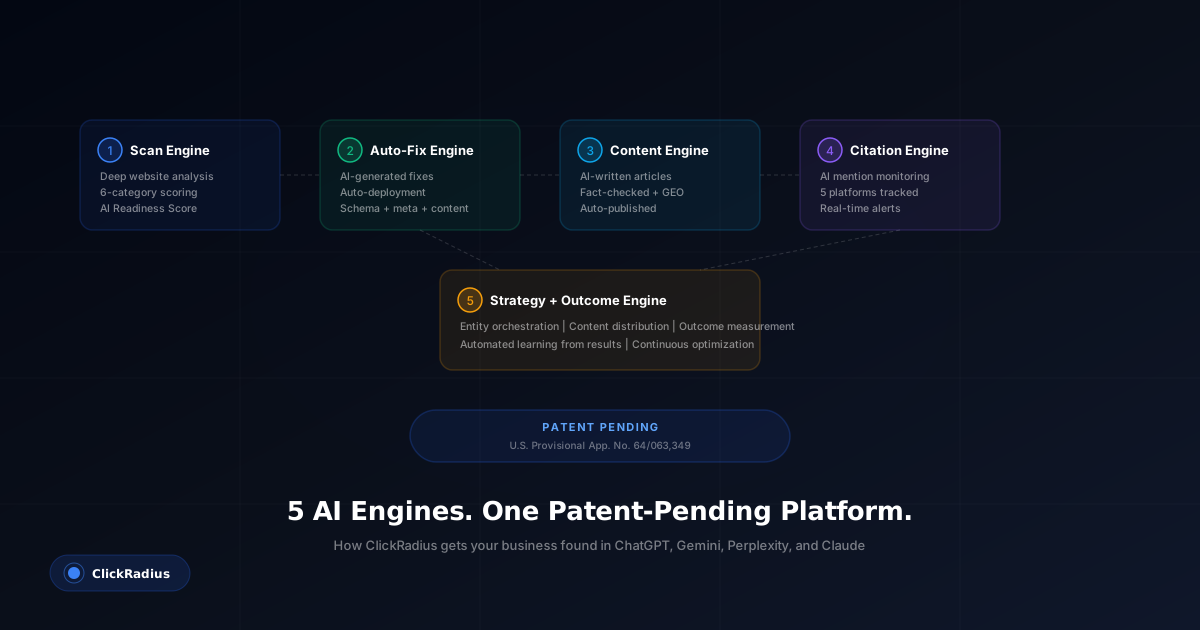
The 5-Engine Architecture
ClickRadius connects five product systems in a governed workflow. Scans can identify evidence-backed gaps, eligible work can be prepared, and an exact supported effect can proceed only through its applicable authorization and capability controls. Subsequent observations record what their instruments can see without treating a sequence as proof of causation.
Here's what each engine does and why it matters.
Scan Engine — AI-Powered Crawler + Five-Family AI Readiness Scoring
The Scan Engine fetches the public response available to its instrument and evaluates observable evidence such as structured data, meta architecture, content signals and crawler access. It does not reproduce every external engine's private crawler, index or retrieval system.
AI Readiness is scored across five weighted evidence families: Off-site Authority (28%), On-page GEO (26%), Schema Engine (18%), Entity / E-E-A-T (18%) and Crawler Access (10%). SEO Health and measured AI Presence are reported separately and are never blended into it. The weights are starting estimates, not weights fitted to customer outcomes, and the score is not a citation prediction.
Auto-Fix Engine — Prepared Corrections with Governed Execution
When the Scan Engine identifies a supported issue, the Auto-Fix Engine can prepare an eligible correction such as schema markup or metadata. Applying a supported site effect requires current authorization and a capable connection; otherwise the correction remains for review or customer implementation.
For an applied effect, ClickRadius records the provider receipt separately from an independent public-origin reread. A JavaScript-snippet effect is client-side and cannot be verified in the raw public-origin response, so that state remains explicitly unverified rather than being promoted to success. Neither delivery state proves external-engine observation.
Content Engine — AI-Assisted Drafts with Admission Controls
The Content Engine can prepare eligible blog and knowledge-article drafts around identified coverage gaps. Draft generation is not publication and does not establish authority by itself.
Source, factual, authorship and approval controls remain part of the content workflow. Eligible publication requires the applicable approval or exact automatic-execution acknowledgment, current authorization and a capable destination connection; otherwise the draft remains for review. External engines decide whether to retrieve or cite published material.
Schema Engine — Structured Data Architecture
Structured data provides machine-readable declarations, but it does not prove that a claim is true or guarantee that an engine will use it. The Schema Engine audits observable markup, identifies supported gaps and can prepare eligible schema corrections.
The current homepage generator prepares one applicable, fact-authorized Organization or more specific business node. It withholds unconfirmed template-derived service, FAQ, breadcrumb and rating claims. Generation remains separate from publication; applying the exact node requires current authority and a proven-capable connection, and a provider receipt remains separate from public-origin reread.
Health Monitor — Scheduled Measurement
Sites and external answer surfaces change. Scheduled measurements can record changed inputs and answer observations without silently triggering an external site effect.
Citation monitoring runs monthly across ChatGPT, Gemini, Perplexity, Claude and Grok. Each observation retains its engine and sample context. Copilot is not currently supported, and a changed observation is not treated as proof that ClickRadius work caused it.
How the Engines Work Together
The systems form the following evidence sequence:
- Scan Engine crawls your site and produces a detailed, scored assessment across all five evidence families
- Auto-Fix Engine prepares eligible corrections; a supported effect is applied only with current authorization for the exact revision and a capable connection, and otherwise remains for review or customer implementation
- Content Engine prepares drafts that remain subject to source, factual, authorship and publication controls
- Schema Engine audits observable structured data and prepares supported corrections
- Health Monitor records scheduled findings, while citation monitoring records monthly observations across five supported engines
The workflow is repeatable, but it is not an autonomous promise of daily improvement. Each external effect remains approval- and capability-bound, and external engines control their own outcomes.
The ClickRadius workflow keeps diagnosis, an approved revision, provider delivery, public-origin reread and later external-engine observation as separate evidence states.
Current Workflow Contract
| Workflow question | Current ClickRadius record | Boundary |
|---|---|---|
| What was measured? | Public-response and supported-source findings | An unavailable instrument remains unknown |
| How is readiness summarized? | Five disclosed evidence families | Expert-set starting weights, not provider weights or outcome-fitted coefficients |
| What schema is prepared? | One applicable, fact-authorized homepage business node | Unconfirmed template claims are withheld |
| What metadata is prepared? | Exact homepage title and description package | No claim of site-wide, canonical, social-card, or header delivery |
| What content can enter the governed path? | Eligible blog and knowledge articles | Source, factual, authorship, approval, authority, and destination controls still apply |
| When can a site effect proceed? | After exact approval or an applicable runtime-enforced automatic acknowledgment | Current site authority and effect-specific connector capability are still required |
| What proves delivery? | Effect-specific provider receipt | It does not prove a public-origin response or external-engine observation |
| What proves the public response? | Independent public-origin reread where the instrument can observe the effect | A client-side snippet remains outside a raw-origin instrument |
| What is measured externally? | Monthly answer observations across ChatGPT, Gemini, Perplexity, Claude and Grok | Copilot is not supported; the sample is not continuous or causal proof |
Where Automation Helps — and Where Authority Still Governs
Automation can reduce repetitive analysis and preparation. It does not remove responsibility for factual accuracy, customer authority, connector capability or protected content.
Some technical checks are mechanically testable, while the wording, business facts and effect authority still require their appropriate controls. ClickRadius can prepare eligible corrections and retain the evidence needed to decide whether a supported change may be applied.
A governed system can make repetitive work easier to inspect and execute without claiming that every page is eligible, every connector is capable, or any external outcome is guaranteed.
The Integrated Workflow
ClickRadius identifies its technology as Patent Pending. Product capability and legal scope remain distinct: the platform connects scanning, fix generation, governed deployment, content workflow, and health monitoring while preserving authorization and verification state for each action.
The design addresses the implementation gap between a diagnostic report and an approved, verifiable change. As AI search evolves, that operational distinction matters: a recommendation is not a deployment, and a deployment is not an observed outcome.
What This Means for Your Business
If an existing workflow stops at diagnosis, ClickRadius can add prepared corrections and explicit delivery evidence. Whether a particular site effect can proceed depends on current authorization and connector capability.
ClickRadius combines a five-family AI Readiness Score, separate SEO Health, prepared eligible corrections, content and schema workflows, and monthly citation monitoring across five engines. Unsupported or unauthorized work remains for review or customer implementation, and external engines decide citation outcomes.
Run a free AI Readiness analysis to inspect the five supported evidence families available for a submitted URL. The score is separate from monthly AI Presence and does not predict a citation. Public paid enrollment and automatic live-site changes remain closed until the launch gates shown above are accepted.