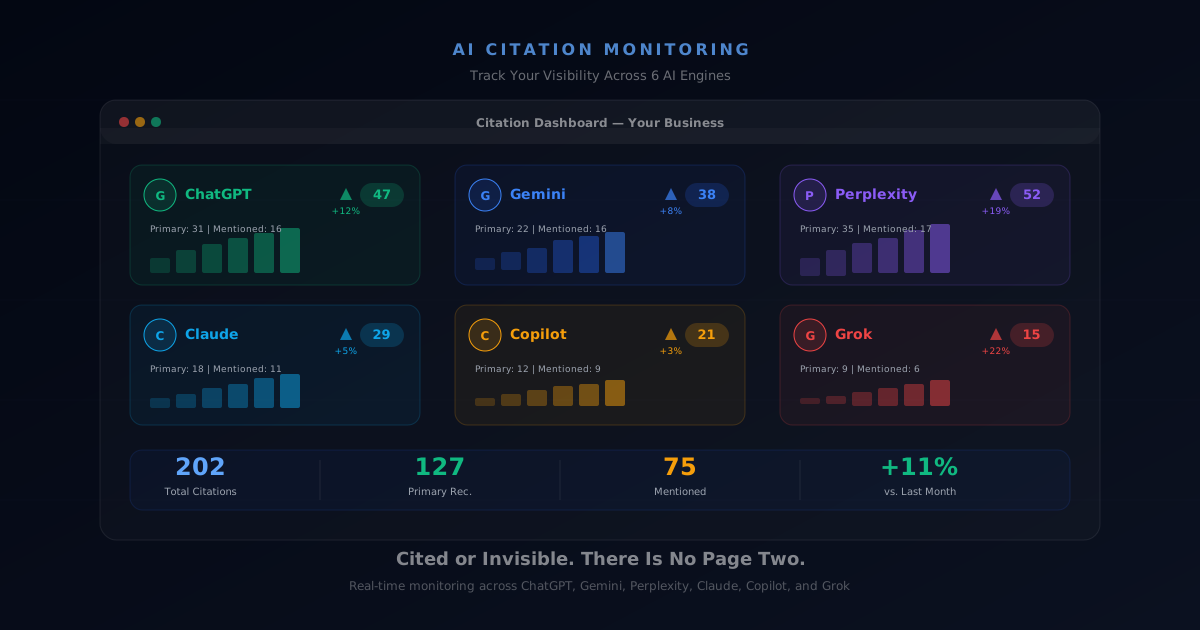
What Citation Monitoring Records
Rank tracking and citation monitoring observe different surfaces. A rank record describes a tested search result; a citation record describes whether a tested AI response named or linked a business. Neither observation represents every result another user received.
An answer surface may contain prose, links, cards or other interface elements. ClickRadius does not infer a universal result format. It records the tested prompt, provider, returned answer, available source evidence and observation time so the result can be interpreted within that scope.
A manual query is valid evidence of that response. Repeating a fixed protocol across supported engines and later observation dates makes the samples comparable, but it does not turn them into a census of all prompts, users, locations, interfaces or model versions.
Five Supported AI Engines and the Copilot Boundary
ClickRadius records monthly sampled responses from five configured engine integrations: ChatGPT, Gemini, Perplexity, Claude and Grok. Microsoft Copilot is not currently supported and is not included in ClickRadius measurement data. Each stored result describes the tested request and response, not an engine's entire audience or every answer it produced.
ChatGPT (OpenAI)
ChatGPT is one of the five supported engines in ClickRadius's monthly citation sample. ClickRadius retains the tested prompt, returned answer and available source evidence. That observation does not represent every ChatGPT product surface or establish how OpenAI selected the response.
Gemini (Google)
Gemini is one of the five supported engines in ClickRadius's monthly citation sample. The recorded response is evidence from that sampled Gemini request; it does not establish separate coverage of every Google answer surface or disclose Google's retrieval and citation logic.
Perplexity
Perplexity is one of the five supported engines in ClickRadius's monthly citation sample. Its visible source links make the sampled citation evidence inspectable, but a link does not guarantee referral traffic or reveal why Perplexity selected the source.
Claude (Anthropic)
Claude is one of the five supported engines in ClickRadius's monthly citation sample. The sample records the returned answer and available citation evidence; it does not infer Claude's unpublished selection standard or promise that stronger inputs will produce a citation.
Microsoft Copilot
Microsoft Copilot is a separate answer surface. ClickRadius does not currently support or report Copilot observations, and this page makes no promise about future integration or timing. Use a separate manual protocol and retain its prompt, response and observation time rather than combining it with ClickRadius's five-engine data.
Grok (xAI)
Grok is one of the five supported engines in ClickRadius's monthly citation sample. Its returned answer is kept distinct by engine and observation date; ClickRadius does not claim access to Grok's internal source weighting or guarantee what a later response will contain.
A retained answer proves what the tested engine returned for that request. Comparable monthly samples can show a difference; they do not explain its cause or represent the whole market.
What We Track: Beyond Simple Mention Counts
A mention count needs its instrument: the fixed questions, engine, date, answer, and cited sources. ClickRadius records that evidence monthly across ChatGPT, Gemini, Perplexity, Claude, and Grok. It is a bounded sample rather than a continuous or statistically representative view of every answer.
Citation Frequency
Within each monthly sample, ClickRadius can count how many eligible tested responses mention or cite the business. The denominator is the fixed sampled question set, not all consumer activity, and the product does not claim a separate seven-day, thirty-day or ninety-day collection cadence.
Citation Context
A primary recommendation, a list mention, and a linked source are different observations and should not be blended. ClickRadius's monthly five-engine sample preserves the response context so the evidence can be reviewed. The wording in one sampled answer does not guarantee that the next answer will use the same framing.
Competitor Citations
ClickRadius's monthly sample can preserve other businesses named in the same recorded responses. Comparisons require the same questions, engines, and counting rules across observation dates. A new appearance is evidence of that sampled response, not proof of a durable share-of-voice change or its cause.
Citation Trends
A single response is a narrow observation. ClickRadius records citation frequency and context monthly across the five supported engines so comparable samples can be viewed over time. Those records can show what changed in the sample; they cannot by themselves prove that an optimization worked or that a competitor's position changed outside the measured questions.
Query Coverage
Different sampled questions can return different citation observations. A review can compare the exact prompts and retained answers, then investigate controllable site or off-site evidence. The difference alone does not identify a content gap, entity problem or corrective action.
What Manual Citation Checks Can and Cannot Show
You can run a manual check, and it is valid evidence of that response. The limitation is scope: one answer cannot establish a stable citation rate or represent other engines, prompts, times, accounts or locations.
Response variation. A repeated query can return a different answer. Retain the exact prompt, engine, response and time, and describe the result as a sample. ClickRadius does not label its monthly collection statistically representative of every user response.
Request context. Account, product surface, location, model and prior context may differ between observations. Preserve the conditions that are available; do not label one account's response as what a typical consumer sees without a representative protocol.
Geographic scope. A request with one stated or inferred location does not establish the response for another location. A location comparison needs separately retained observations under the same protocol.
Engine-specific observations. A ChatGPT response cannot be imputed to Claude or another engine. ClickRadius samples ChatGPT, Gemini, Perplexity, Claude and Grok monthly. Microsoft Copilot is not currently supported and remains a separate manual check.
Time. Answers can change over time, but ClickRadius does not watch them continuously. Month-over-month comparisons describe retained samples; they do not prove why a response changed.
Why Repeated Observations Matter
A citation in one response is not evidence that it will create another citation. The defensible loop is operational: observe, retain the evidence, review controllable inputs, authorize a specific revision if appropriate, and observe again later.
ClickRadius does not know whether a provider will use any sampled response as training or reference data, and it does not claim a self-reinforcing advantage. External providers control training, retrieval, ranking and citation. A later observation can show a difference, but attribution remains unknown unless independent evidence establishes it.
The useful feedback loop stays inside the evidence boundary: compare like-for-like observations, inspect the underlying response and source evidence, propose a specific revision when justified, obtain the required authority, and measure again. A sample does not prove that a named competitor gained a durable advantage or that a proposed change will affect a later answer.
Observation, explanation and intervention are separate stages. ClickRadius retains the observation and supports review; external engines decide future answers.
How to Interpret Your Citation Data
Interpret every dashboard comparison against the same eligible prompt set, engine set, counting rules and observation cadence:
- Primary versus mentioned: review the retained response context and apply the same classification rule. The label does not measure an engine's confidence or the business's authority.
- Present versus absent: state the numerator and eligible sampled-response denominator. Absence in a sample is not proof of absence from every answer.
- Change between months: confirm that prompts, engines and counting rules are comparable. A difference does not establish that an optimization caused it.
- Other businesses named: preserve the exact co-mention evidence. Do not infer durable market share or a competitor's strategy from one response.
- Differences between engines: report each engine separately. The observations do not reveal private provider weights or identify a specific signal to target.
Connecting Citation Monitoring to Optimization
A monthly citation observation can inform the next review, but it does not itself authorize a site effect or prove what action is highest impact. ClickRadius retains decision evidence and may prepare a proposed revision. It executes that exact revision only with current authorization and a connection proven capable of the effect; otherwise the work remains for review or customer implementation.
The next monthly sample can be compared with the earlier one. A difference is a signal to investigate, not proof of decline across all users, proof that a change caused an improvement, or a guarantee that an external engine will preserve it.
For a deeper look at the evidence needed to classify returned answers, see our guide on measuring AI-answer mentions and citations and our overview of AI-answer readiness and presence.
Get your free AI Readiness Score for a five-family estimate of observed site inputs. Paid monitoring separately records monthly answer and citation samples from ChatGPT, Gemini, Perplexity, Claude and Grok. Microsoft Copilot is not currently supported; neither surface shows every answer or predicts a future citation.