The Problem with Rules-Based SEO

Every SEO platform you have used operates on the same basic principle: apply a fixed set of rules to every website and report deviations. Missing schema markup? Flag it. Title tag too long? Flag it. No HTTPS? Flag it. The rules are the same whether you are a healthcare practice in Phoenix, a SaaS startup in San Francisco, or a retail chain in Atlanta.

This approach works for identifying obvious technical errors. It fails entirely when the question shifts from "what is wrong?" to "what should we fix first to produce the biggest improvement?" The answer to that question depends on context that rules cannot capture: your industry, your competitive landscape, your content strengths and weaknesses, your technical infrastructure, and even your geographic market.

A healthcare site with excellent clinical content but missing schema markup will see massive improvements from structured data fixes. A retail site that already has perfect schema but thin product descriptions will see zero improvement from the same fix. Rules-based systems treat both sites identically. An adaptive system learns the difference.

Beta(α, β)
The Bayesian prior that powers every optimization decision in the ClickRadius Strategy Engine

What Is Thompson Sampling?

Thompson Sampling is a Bayesian approach to the multi-armed bandit problem — one of the oldest and most studied problems in probability theory and decision science. The multi-armed bandit problem, named after a row of slot machines (one-armed bandits), asks a simple question: given multiple options with unknown payoff rates, how do you maximize your total reward over time?

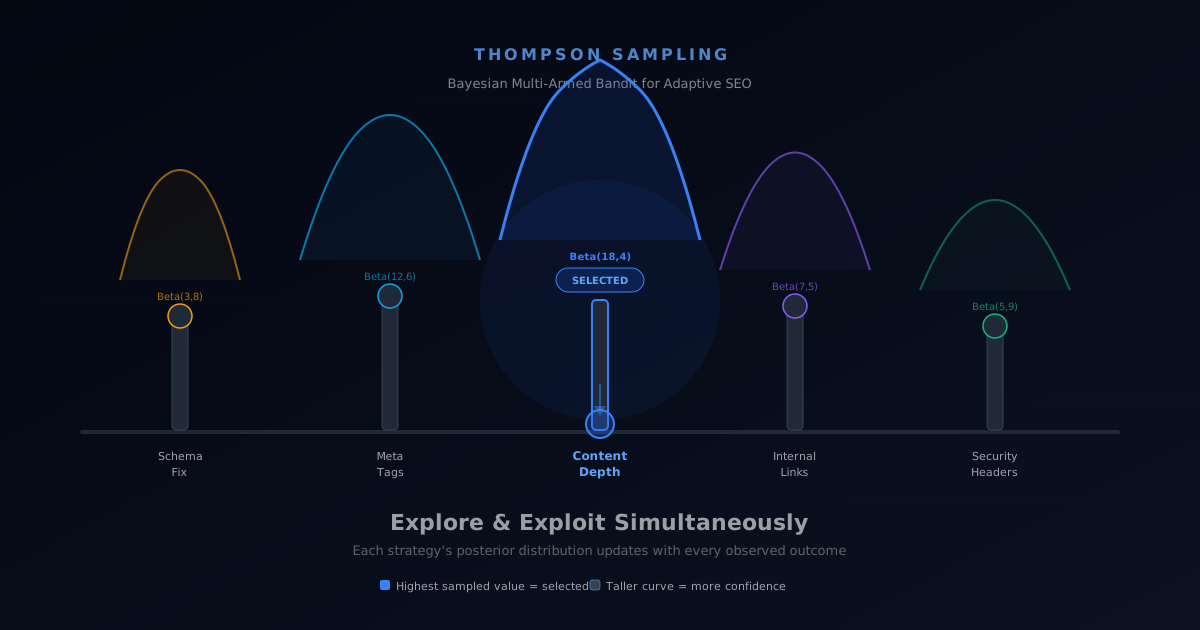
The naive approaches each have fatal flaws. Pure exploration — trying every option equally — wastes resources on options that are clearly inferior. Pure exploitation — always choosing the option that has performed best so far — gets stuck on early winners and never discovers better alternatives. The key insight of Thompson Sampling is that it explores and exploits simultaneously by maintaining a probability distribution over each option's true success rate.

The Beta-Binomial Model

ClickRadius uses a Beta-Binomial model for each optimization strategy. Here is how it works in plain language:

Every optimization strategy (schema fixes, meta tag optimization, content depth improvements, internal linking, security hardening, and so on) is modeled as a Beta distribution with two parameters: alpha (α) and beta (β). Alpha represents the number of successes (times the strategy produced a measurable score improvement). Beta represents the number of failures (times it did not). Both start at 1, representing total uncertainty — we have no prior belief about whether the strategy will work or not.

Each time the Strategy Engine needs to decide which optimization to deploy next, it draws a random sample from each strategy's Beta distribution. The strategy with the highest sampled value gets selected. After the optimization is deployed and the outcome is measured, the selected strategy's distribution is updated: alpha increases by 1 if the fix improved the score, or beta increases by 1 if it did not.

Thompson Sampling does not pick the strategy that has worked best in the past. It picks the strategy that is most likely to work best right now, accounting for both performance history and uncertainty.

Why This Beats A/B Testing

Traditional A/B testing requires you to define a fixed experiment, split traffic evenly between variants, wait for statistical significance, and then implement the winner. This process is slow, expensive, and wasteful — you are forced to serve the losing variant to half your traffic for the entire duration of the test.

Thompson Sampling converges on the best option naturally, without fixed experiment boundaries. As evidence accumulates that one strategy outperforms others, the algorithm automatically allocates more attempts to the winning strategy while still occasionally testing alternatives in case the landscape has shifted. This is called the explore-exploit tradeoff, and Thompson Sampling is mathematically proven to handle it near-optimally.

40-60%
faster convergence than traditional A/B testing in published research
0%
traffic wasted on known-inferior variants during testing
continuous adaptation — the algorithm never stops learning

How ClickRadius Applies Thompson Sampling

The ClickRadius Strategy Engine (part of the patent-pending architecture, U.S. Provisional App. No. 64/063,349) uses Thompson Sampling to make three categories of decisions for each site it manages.

1. Optimization Strategy Selection

When the engine has multiple fix categories available for a site, it must decide which to deploy first. Should it prioritize schema markup, meta tag optimization, content depth, internal linking, or security headers? The answer depends on what has worked for this specific site in the past. A healthcare site might have a Beta(18, 4) distribution for schema fixes (high confidence, high success rate) and a Beta(5, 9) for internal linking (moderate confidence, low success rate). The engine samples from each distribution and acts on the result.

2. Content Strategy Optimization

When the Content Engine generates citation-optimized pages, Thompson Sampling guides topic selection, content format, and depth. If long-form FAQ pages have consistently improved citation rates for sites in the healthcare vertical, the algorithm will favor that format — but it will still occasionally test other formats (how-to guides, comparison pages, glossary entries) to discover if the landscape has shifted.

3. Deployment Method Selection

Fixes can be deployed through multiple channels: WordPress REST API, JavaScript injection via Cloudflare Worker, or direct CMS integration. The success rate of each deployment method varies by site architecture. Thompson Sampling learns which method works most reliably for each specific site and favors that method in future deployments, while still occasionally testing alternatives.

Statistical Significance: Welch's t-Test

Thompson Sampling handles the exploration-exploitation tradeoff, but the system also needs to determine whether an observed score improvement is statistically significant or just noise. For this, ClickRadius uses Welch's t-test — a variation of the standard t-test that does not assume equal variances between the two groups being compared.

After each optimization is deployed, the engine compares the pre-fix scores against the post-fix scores across multiple re-scans. Welch's t-test produces a p-value indicating the probability that the observed difference occurred by chance. Only improvements that meet a significance threshold (p < 0.05) are counted as successes that update the Thompson Sampling distribution. This prevents the system from learning false patterns from noisy data.

Why Welch's t-test Instead of Student's t-test?

The standard Student's t-test assumes that both groups have equal variance. In SEO optimization, this assumption is almost never valid. Pre-fix scores tend to have different variance characteristics than post-fix scores because the fix itself changes the distribution of possible outcomes. Welch's t-test handles unequal variances correctly, producing more reliable p-values and preventing the system from over-counting marginal improvements as significant wins.

Practical Example: Healthcare vs. Retail

Consider two sites on the ClickRadius platform. Site A is a dental practice. Site B is an e-commerce clothing retailer. Both start with similar AI Readiness scores around 35 out of 100.

After 30 days of optimization, the Strategy Engine has learned dramatically different lessons for each:

Site A (Dental Practice): Schema fixes produced the largest score improvements, with a Beta(14, 2) distribution — 87.5% observed success rate. This makes sense: healthcare sites benefit enormously from structured data because AI engines heavily weight medical entity signals when recommending practitioners. Content depth fixes also performed well at Beta(10, 4), because clinical content authority is a major AI citation factor in healthcare.

Site B (Clothing Retailer): Schema fixes produced modest improvements, with a Beta(6, 8) distribution — only 42.9% success rate. The site already had basic product schema from its e-commerce platform. What produced the biggest gains was content depth, at Beta(12, 3), because the retailer's thin product descriptions were the primary gap preventing AI citations. Security headers also scored well at Beta(8, 3), because the site had multiple mixed-content warnings that degraded trust signals.

The same optimization strategy that is transformative for one site can be irrelevant for another. Only an adaptive algorithm can learn these differences automatically.

A rules-based system would have prescribed the same fix sequence for both sites. Thompson Sampling allocated resources where they actually produced results, converging on the right strategy for each site's unique context within weeks.

The Patent-Pending Innovation

The application of Thompson Sampling to SEO optimization — specifically, the closed-loop system where the same scoring kernel that identifies opportunities also measures outcomes and updates the Bayesian priors — is part of the ClickRadius patent-pending technology (U.S. Provisional App. No. 64/063,349).

What makes this novel is not Thompson Sampling itself, which has been studied since 1933 when William R. Thompson first published it. The innovation is the integration of three components into a single adaptive system:

  1. Unified scoring kernel: The same engine that identifies issues also measures whether fixes worked, eliminating the gap between diagnosis and outcome measurement that plagues all other SEO platforms.
  2. Bayesian strategy selection: Thompson Sampling with Beta-Binomial priors, updated in real time as each optimization's outcome is observed, ensuring the system gets smarter with every deployment.
  3. Statistical verification: Welch's t-test ensures that only genuinely significant improvements update the priors, preventing the system from learning false patterns from noisy data.

This architecture means that ClickRadius does not just optimize websites — it optimizes how it optimizes websites, continuously refining its strategy based on empirical evidence rather than static rules.

Since 1933
Thompson Sampling has been studied and proven near-optimal
p < 0.05
statistical significance threshold for prior updates
Real-time
Bayesian priors update after every observed outcome

Why This Matters for Your Business

You do not need to understand the mathematics of Thompson Sampling to benefit from it. What matters is the practical outcome: ClickRadius learns what works for your specific site, in your specific industry, against your specific competitors — and it gets better at optimizing your site with every cycle.

Every other SEO platform applies the same checklist to every site. ClickRadius builds a unique optimization model for yours. As described in our piece on auto-fix vs. manual SEO, this adaptive approach is what makes it possible to automate the entire fix pipeline — the system does not just know what to fix, it knows what to fix first to produce the maximum improvement in the minimum time.

That adaptive intelligence is what separates a tool that generates reports from a system that generates results.

See Thompson Sampling in action on your own site. ClickRadius scans, scores, and begins learning which optimizations will produce the biggest improvements for your unique context. Get your free AI Readiness Score to start the adaptive optimization engine.