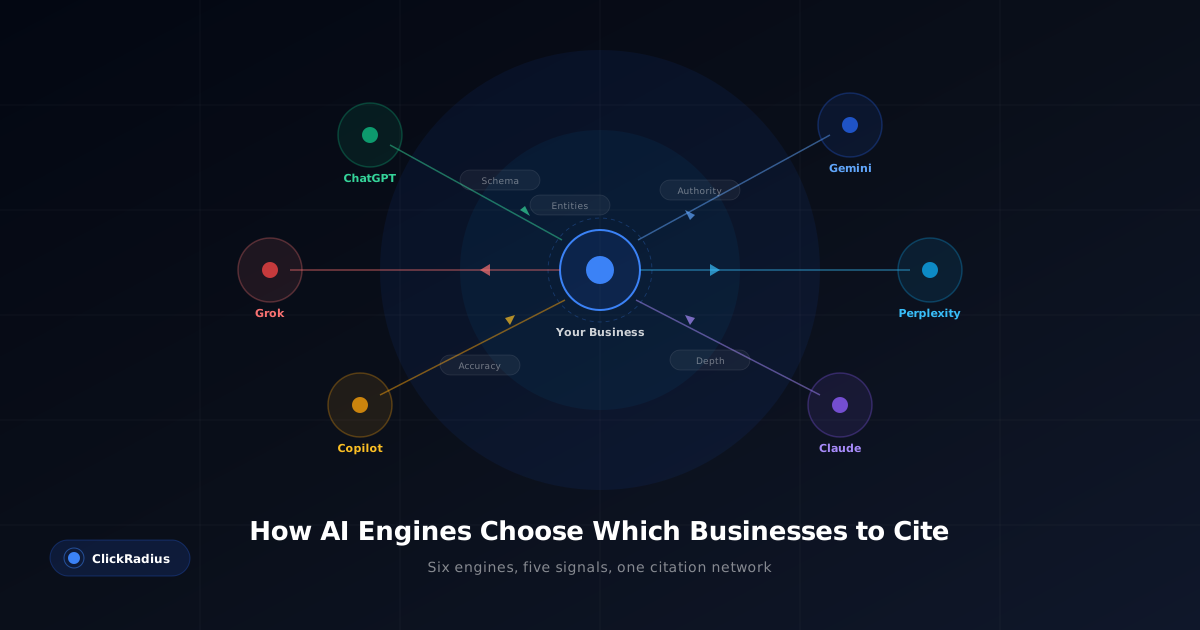
Generated-answer products can return prose, cards, ordinary links, source links, maps, recommendations, or no usable business result. The format and content can change by provider, product mode, prompt, model, locale, account context, and time.
The observable evidence is the request and response. A public result does not disclose the complete candidate set, private retrieval and ranking stages, unseen sources, internal weights, or the reason one business appeared. Generative Engine Optimization (GEO) can improve publisher-controlled inputs and measure responses, but it cannot replace that missing internal evidence with a universal formula.
Start With the Observation Contract
For every check, retain the exact prompt, named provider and surface, available model or endpoint, locale and account context where relevant, collection time, returned answer, visible source links, and request outcome. A failed or unavailable response is unknown coverage, not a zero.
Classify the result without collapsing distinct states:
- Mention — the returned answer names the business.
- Linked citation — the returned surface associates a source link with the relevant statement or answer.
- Recommendation — the response affirmatively presents the business as an option under a disclosed counting rule.
- Absence — the business does not appear in the successfully returned sample.
- Unknown — the request failed, coverage was unavailable, or the result could not be classified reliably.
Five Readiness Families, Not Five Provider Signals
ClickRadius uses five disclosed evidence families to estimate controllable readiness inputs. The weights are expert-set starting estimates, not weights fitted to customer outcomes and not claims about any provider's private behavior:
1. Off-site Authority (28%)
This family inventories independently observed listings, reviews, media and social references, links, and entity records. It can identify an evidence gap or conflict; it does not establish that an engine retrieved the source or assign causal credit to it.
2. On-page GEO (26%)
This family evaluates answer structure, specific claims, source-bearing passages, non-promotional context, and other observable content-rubric inputs. Those qualities can be reviewed on the page; the family does not establish retrieval, citation, or provider preference.
3. Schema Engine (18%)
This family evaluates observed structured-data evidence. Markup supplies machine-readable declarations where a consumer supports them; it does not verify the facts or create citation eligibility. The structured-data guide separates vocabulary, provider support, publication, and outcome.
A readiness score describes the evidence ClickRadius measured. Only a retained answer can establish what a named provider returned for a named request.
4. Entity / E-E-A-T (18%)
This family evaluates current evidence for an entity record, identifiable authors, independently verifiable credentials, and consistency between first-party and independent facts. It is an audit rubric, not a provider credibility score. The entity-record playbook explains the source and authority boundaries.
5. Crawler Access (10%)
This family records the crawl policy exposed by the site and the presence of an llms.txt file. Policy is not proof that a provider reached, indexed, retrieved, or cited the page. Google separately states that no special AI text file is required for its AI features.
Compare Providers Without Inventing Their Internals
Providers expose different products, interfaces, source treatments, and response formats, and those details can change. Compare what each named surface returned under the same disclosed protocol; do not extrapolate a private architecture or signal weight from the answer.
ChatGPT
Record the exact ChatGPT surface or endpoint, prompt, response, available model identifier, source evidence, and time. One response does not represent every ChatGPT product mode or disclose why OpenAI selected a business or source.
Gemini
Record the exact Gemini surface or endpoint and keep it separate from Google Search AI Overviews, AI Mode, Business Profile, and other Google products. A Gemini result does not establish a fixed relationship among those products or a weight for any source.
Perplexity
Where Perplexity displays source links, retain each visible link and its relationship to the returned answer. A displayed link makes that sample inspectable; it does not prove referral traffic, causal selection, or the response another user received.
Claude
Record the tested Claude surface or endpoint, prompt, response, available model identifier, citation evidence, and time. Do not infer an undocumented preference for a source or content style from one result.
Copilot
Microsoft Copilot is not currently supported by ClickRadius monthly monitoring and is not included in its AI Presence data. A separate manual protocol must name the Copilot product surface and retain its own prompt, response, context, and observation time.
Grok
Record the tested Grok surface or endpoint, prompt, response, available source evidence, and time. A co-occurring X profile or post does not establish that it caused the response or expose a private source weight.
Structured Data Has a Narrower, Verifiable Claim
Structured data can express visible page facts in a machine-readable vocabulary. Google says its AI Search features require no special Schema.org markup and that structured data should match visible text. Other providers control their own support. Valid markup does not prove truth, provider use, citation, or a relative advantage over unstructured content.
Measure vocabulary validity, factual agreement, publication state, public readback, and external answer outcomes separately. The schema guide documents those boundaries and the current ClickRadius generation path.
Entity Consistency Is an Audit Input, Not an Outcome Formula
Compare public business records to find material conflicts in identity, location, service area, hours, phone, category, or website. Preserve legitimate aliases, tracking numbers, departments, and location-specific facts. A formatting difference is not automatically an identity error.
Correcting an inaccurate record has direct customer value. It does not disclose whether an answer provider consulted the record or how the provider resolved a subject.
Accurate records and a returned AI answer are separate evidence surfaces. Do not turn the first into a promise about the second.
Why a citation does not prove a feedback loop
A captured citation proves only what the named answer surface returned for that prompt and time. It does not show whether a future model will ingest the answer, whether a user will repeat or share it, or whether any later source-selection decision was influenced by it.
Starting measurement earlier provides an earlier baseline and more elapsed observations. It does not establish a persistent citation pattern, an advantage through model updates, or a competitive penalty for delay.
How ClickRadius Records Supported Answer Samples
ClickRadius records monthly answer and citation observations from ChatGPT, Gemini, Perplexity, Claude and Grok. Microsoft Copilot is not currently supported. The retained prompt, response, engine and time show what happened in that sample; they do not reveal what every query triggers or why an engine selected a source.
Compare the five supported engines separately and date every observation. Microsoft Copilot is not currently supported by ClickRadius, and no single engine's returned answer establishes a universal strategy for another.
ClickRadius keeps each prepared change, authorized effect, provider receipt, public reread, readiness observation, and monthly AI Presence result in its own evidence state. A change in one area does not receive causal credit for another outcome without supporting evidence.
Want a baseline? The free AI Readiness Score estimates five families of site inputs and remains separate from monthly AI Presence observations across ChatGPT, Gemini, Perplexity, Claude and Grok. Microsoft Copilot is not currently supported. The score does not contact all five engines or forecast a citation. Get your score now.