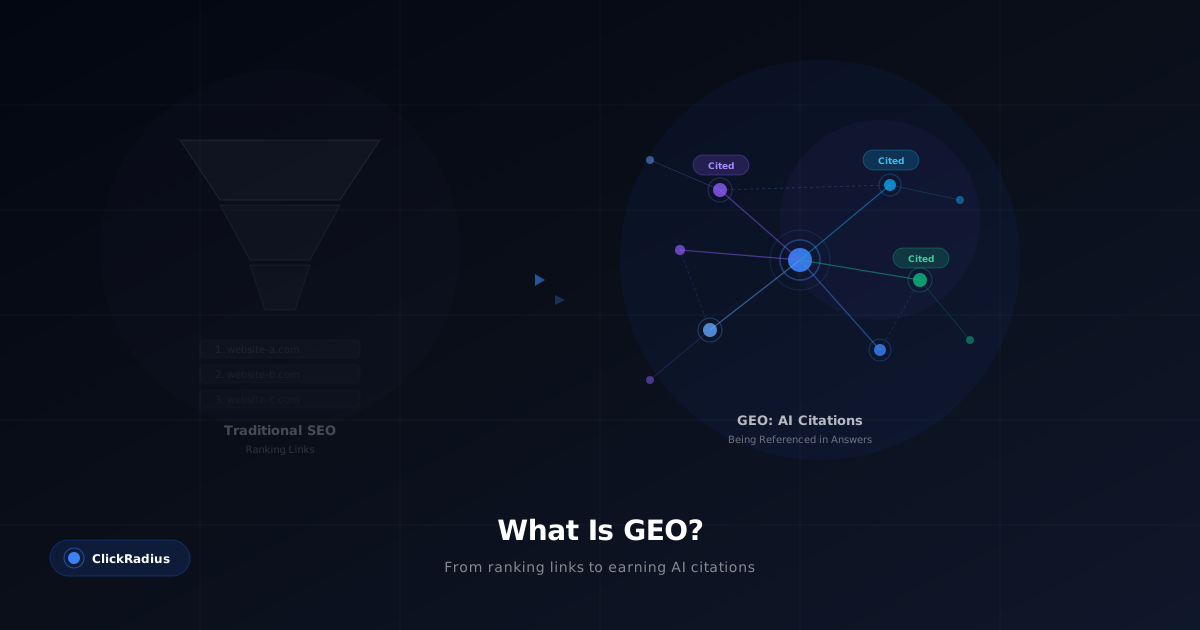
People can discover information through conventional search results, maps, shopping and local modules, social and video platforms, and generated-answer products. Those surfaces coexist. A ranking on one does not establish a mention, linked citation, or recommendation on another.
Generative Engine Optimization, or GEO, is an evolving industry term rather than one provider-defined standard. ClickRadius uses it for two separate jobs: improving factual, structural, technical, and off-site evidence a publisher can control, and measuring what named answer surfaces return under a disclosed protocol.
Defining GEO: What It Is and What It Is Not
GEO can cover crawl access, useful first-party content, accurate structured data, entity records, independent corroboration, and answer observation. It cannot guarantee that an external provider will crawl, index, retrieve, rank, mention, cite, recommend, or persist a source.
Do not reduce GEO to a binary “cited or invisible” model. A response may contain a mention without a link, a linked source without a business recommendation, several options, an ordinary search result, a map, or no usable result. Each needs its own counting rule.
GEO is not a replacement for SEO. Google's current guidance for AI features in Search says ordinary SEO foundations remain relevant and no special Schema.org type is required. Other answer providers have their own products and changing documentation.
How GEO Differs from Traditional SEO
The useful distinction is between evidence surfaces, not between two universal algorithms. Conventional SEO can measure crawl, index, ranking, search appearance, and traffic. GEO work can add answer-level observations and a broader inventory of publisher-controlled and independent evidence.
Ranking vs. Citation
A rank and a citation are different records. Some answer surfaces also display ranked links, maps, cards, or multiple recommendations, so “you cannot rank” is too broad. Preserve the actual interface and classify only what it shows.
Pages vs. Entities
A page and an entity are both relevant records. A page has content and a URL; an organization may be represented by first-party pages and applicable public records. The entity-record audit playbook explains how to compare those sources without assuming a mandatory platform list or hidden provider score.
Backlinks vs. Entity Signals
Links, independent mentions, business profiles, reviews, and knowledge-base records have different publishers and meanings. Their relative use cannot be inferred from a public answer. Inventory them as evidence, then measure named provider outcomes separately.
GEO improves evidence the publisher can control and records answer outcomes the publisher cannot control.
Inspectable Inputs, Not Private Provider Weights
ClickRadius records monthly answer and citation observations from ChatGPT, Gemini, Perplexity, Claude and Grok; Microsoft Copilot is not currently supported. Those samples do not identify a private engine formula or prove which input caused a citation. The five AI Readiness families are a transparent starting model for controllable evidence, and their weights have not been fitted to customer outcomes.
Off-site Authority (28%)
Inventory independently observed listings, reviews, media and social references, links, and entity records. This is setup evidence, not proof that an AI provider retrieved or weighted a source.
On-page GEO (26%)
Inspect answer structure, source-bearing passages, specific claims, and non-promotional context under the current rubric. Those qualities can be reviewed on the page; they do not establish retrieval or citation.
Schema Engine (18%)
Inspect structured-data presence, applicability, and supported validity. Markup describes visible facts where a consumer supports it; it does not independently verify those facts or guarantee display or citation. See the current schema boundary.
Entity / E-E-A-T (18%)
Inspect entity records, identifiable authors, independently verifiable credentials, and consistency between first-party and independent facts. This is an expert-set rubric, not an external provider's trust score.
Crawler Access (10%)
Inspect the crawl policy exposed by the site and whether it publishes llms.txt. A declared policy does not prove that an engine reached, indexed, retrieved, or cited the page.
Why One Result Surface Cannot Substitute for Another
A strong conventional ranking does not prove that a different provider mentioned or cited the business. The reverse is also true: a mention in one sampled answer does not establish a conventional rank, impression, visit, lead, or sale.
Measure each surface with its own instrument. For answer products, retain the prompt, engine, available model or surface, locale and account context where relevant, returned answer, visible sources, time, and successful-response denominator.
A difference between the two records is a finding to investigate. It does not prove that missing schema, a directory, or another readiness input caused the difference.
Why Early Measurement Is Not a Compounding-Advantage Claim
A citation is one dated answer observation. It does not prove that the answer became a training signal, altered an internal authority score, or influenced a future response. Preserve the prompt, engine, available model or surface, time, answer, and source, then test persistence with comparable samples.
Starting earlier creates an earlier baseline and more time to complete approved work. It does not establish a competitive lead or a growing displacement cost.
Early citations do not establish a compounding advantage. A later citation must be recorded as a new outcome, and its cause remains unknown unless direct evidence supports attribution.
Historical SEO adoption does not establish an analogous AI-citation window. Measure the current business, question set, engines, context, and dates directly.
How ClickRadius Approaches GEO
ClickRadius reports a 0–100 AI Readiness Score across the five disclosed evidence families below. Their weights are expert-set starting estimates, not weights fitted to customer outcomes and not a map of private provider behavior:
- Off-site Authority (28%) — setup and corroboration evidence beyond the owned site.
- On-page GEO (26%) — answer structure, content evidence, and extractability inputs under the current rubric.
- Schema Engine (18%) — observed structured-data presence, applicability, and validity evidence.
- Entity / E-E-A-T (18%) — identity, authorship, credential, and cross-source consistency evidence.
- Crawler Access (10%) — declared crawler access and crawler-hygiene evidence.
After assessment, ClickRadius may prepare content and an eligible on-site revision. It executes that exact revision only with current authorization and a connection proven capable of the effect; otherwise the work remains for review or customer implementation. The platform records monthly, not continuous, answer and citation samples from ChatGPT, Gemini, Perplexity, Claude and Grok. Microsoft Copilot is not currently supported, and external engines still control every answer.
SEO Health is a separate technical-search measure, and AI Presence is a separate monthly answer sample. After assessment, ClickRadius can prepare eligible work, but preparation, factual review, approval, provider acceptance, public readback, indexing, citation, and business outcome remain distinct states. The implementation-gap guide traces those handoffs without publishing an unsupported industry implementation rate.
What the Evidence Can and Cannot Say About Timing
A business cannot infer missed customers from answer samples alone. Establish a fixed panel, record mentions, linked citations, and recommendations separately, and connect any downstream lead only through the business's declared attribution method.
Changes in customer research behavior must be measured for the relevant cohort. Time without GEO work does not by itself create a compounding cost or prove that a competitor is accumulating engine authority.
Starting now creates an earlier baseline and more time to complete approved work. It does not establish that a business will be cited, recommended, or chosen, or that later participants will be excluded.
Run a free AI Readiness analysis to inspect the supported five-family evidence available for a submitted URL. The score is separate from monthly AI Presence and is not a citation forecast. Run a score.