Start With a Measurable Question
A client may ask whether its business appears when people use an AI assistant for a relevant question. A defensible answer identifies the engine, account or locale where relevant, prompt, collection time, returned text, and whether the observation was a mention, linked citation, or recommendation.
Traditional search rankings and traffic do not answer that question by themselves. ClickRadius keeps its five-family AI Readiness estimate and SEO Health separate from monthly sampled AI Presence observations across ChatGPT, Gemini, Perplexity, Claude, and Grok. Microsoft Copilot is not currently supported.
This page describes the current agency program. It does not establish market-wide adoption, client demand, a typical agency price or margin, or a future citation, traffic, retention, or revenue outcome.
What White-Label ClickRadius Gives Your Agency
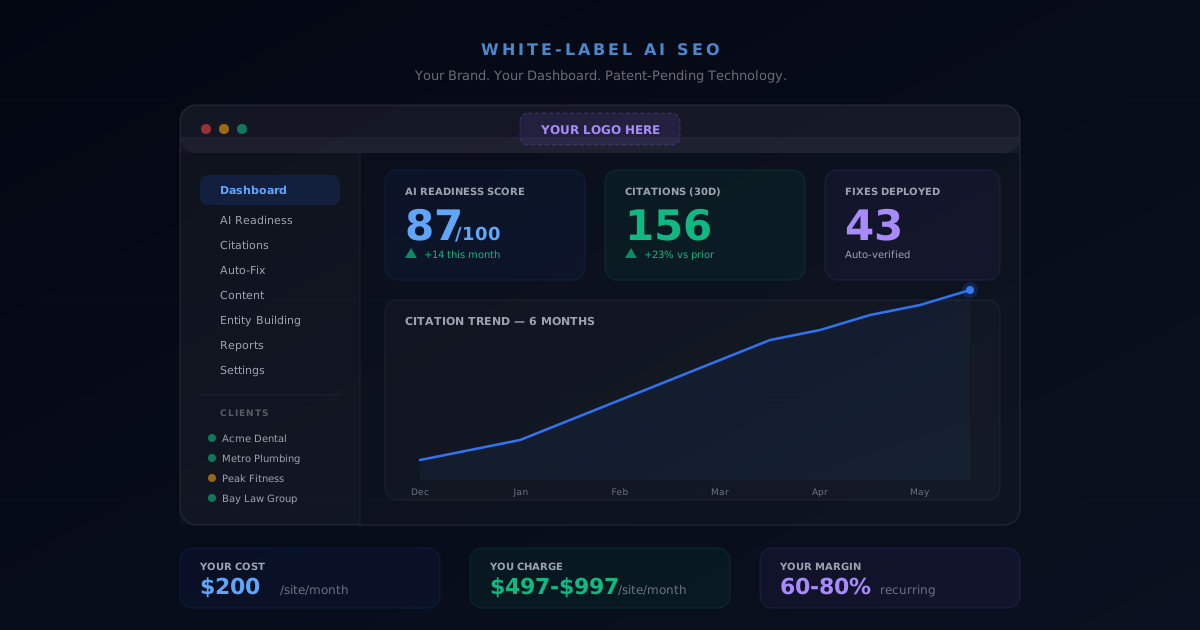
White-label ClickRadius brings scanning, scoring, prepared eligible corrections, content and entity work, monthly citation monitoring across five engines, and reporting into an agency program. Applying a supported site effect requires current authorization and a capable connection; otherwise it remains for agency review or customer implementation. Approved client-facing surfaces can use the agency's branding.
Branded Dashboard
Each client dashboard keeps the five-family AI Readiness estimate separate from monthly answer and citation observations across ChatGPT, Gemini, Perplexity, Claude and Grok. Microsoft Copilot is not currently supported and is not represented as measured dashboard data. The white-label surface uses the agency's configured logo, colors and support contact.
Automated Reports
The program prepares a monthly branded report that distinguishes score evidence, sampled AI Presence observations, and recorded work outcomes. Generation, delivery, and any underlying publication or provider effect retain separate statuses; a report does not turn an attempted task into completed work or prove an external-engine result. The agency remains responsible for review and client context.
AI Readiness Scoring
The AI Readiness Score estimates each submitted website across five weighted evidence families: Off-site Authority (28%), On-page GEO (26%), Schema Engine (18%), Entity / E-E-A-T (18%), and Crawler Access (10%). The family weights are starting estimates, not weights fitted to customer outcomes. AI Readiness is reported separately from SEO Health and measured AI Presence. These measurements document the evidence ClickRadius can observe; they do not guarantee an external citation, ranking, traffic, or revenue outcome.
Auto-Fix Deployment
As we detailed in our analysis of auto-fix vs. manual SEO, implementation is a separate step from finding an issue. ClickRadius identifies findings and prepares eligible corrections. With current authorization and a capable connection, the platform can apply supported changes; otherwise, the work remains for agency review or customer implementation. A provider receipt is recorded separately from an independent public-origin reread, and neither proves that an external engine observed the change.
Citation Monitoring
The citation monitor records monthly sampled responses from ChatGPT, Gemini, Perplexity, Claude and Grok and classifies observed citations and mentions. Microsoft Copilot is not currently supported. Comparisons are limited to the retained prompts and responses; they do not represent every answer or prove an optimization caused a change.
Content Generation
Paid service creates the content-production obligations described in the current agency program. Generated artifacts, factual review, approval, publication, and public-origin verification remain distinct states. Structured data must match visible, verified facts, and neither content nor markup guarantees retrieval, citation, ranking, traffic, or revenue.
Entity Building
ClickRadius can record first-party facts, off-site observations, and eligible work for supported destinations. External publishers control their records, and AI providers control their retrieval and answers. Consistency can reduce factual ambiguity, but ClickRadius has not established it as a universal weighting or a guarantee of citation.
A white-label program can give an agency a disciplined way to ask what a dated prompt panel observed, what evidence changed, and which supported work actually reached its intended public surface.
The Revenue Model
The standard wholesale base is $200 per client site per month. A required score may adjust that price only for objectively larger recurring scope, explains the adjustment before activation, and lets the agency accept or decline it. The agency sets and collects its own client price.
Illustration: 10 Standard-Base Sites
For arithmetic only, consider 10 sites that each remain at the $200 standard wholesale base and an agency-selected client price of $499 per site/month:
- Illustrative monthly client revenue: 10 sites x $499 = $4,990
- Illustrative standard-base wholesale charge: 10 sites x $200 = $2,000
- Illustrative gross spread: $2,990 before any scope adjustment, taxes, payment costs, refunds, support, staffing, sales, or other agency expenses
This is not a price recommendation, profitability forecast, or statement of typical agency performance. Each agency must model its actual client price, accepted site scope, collections, costs, staffing, churn, refunds, and taxes.
Compare the Actual Work and Costs
ClickRadius can reduce repetitive scanning, preparation, monitoring, and reporting work, but it does not eliminate sales, support, strategy, factual review, approval, provider limitations, or client responsibility. Compare the program using the agency's own labor, software, payment, service, and risk costs; no reviewed evidence here establishes a typical margin advantage over traditional SEO.
How to Pitch AI SEO to Your Clients
A useful discovery question is: "For this defined prompt, engine, location or account context, and observation time, what did the returned answer actually say?"
One answer can identify an observed gap in that sample. It does not establish that most businesses are absent, that the same answer persists across users or time, or that a readiness score caused the result.
The Discovery Meeting Framework
- Define the observation: Record the exact prompt, engine, time, location, device or account context where relevant, answer text, and links.
- Separate the scores: Present AI Readiness as a five-family evidence estimate, SEO Health as a separate technical measure, and AI Presence as sampled answer observations — never as one predicted outcome.
- Compare consistently: Use the same retained protocol for the client's business and named comparators. A difference is an observation, not proof of urgency, causation, or an empty market.
- Show governed work: Identify prepared, approved, attempted, provider-confirmed, and publicly reverified states separately. Do not promise a citation timeline.
- Set the commercial scope: The agency chooses its client service and price while preserving ClickRadius's current wholesale, activation, and evidence boundaries.
For Agencies Already Doing SEO
An agency may offer AI-search measurement alongside traditional SEO, but the two evidence sets are not interchangeable. Google and other providers continue to control their own interfaces and results; this page does not establish that AI assistants are replacing Google as consumers' first destination.
Whether an existing client wants that additional scope is a client decision. Explain what ClickRadius measures, what work it can prepare or conditionally apply, what remains outside its control, and how the agency will review and support the service.
No reviewed evidence establishes decade-long retention, a durable first-mover lock-in, or compounding citation outcomes. Retention and value must be measured for the agency's actual clients.
Scalability Requires an Operating Model
Agency capacity depends on client scope, review requirements, support load, exceptions, staff experience, and the work the agency chooses to provide. There is no universal client-to-headcount ratio.
White-label ClickRadius can reduce repetitive scanning, scoring, preparation, monitoring, and reporting work. It prepares eligible corrections and can apply supported changes only with current authorization and a capable connection; otherwise the work remains for agency review or customer implementation. Strategy, factual review, approval, and client responsibility remain with the agency and customer.
Automation may change how much repetitive work a team performs, but it does not prove that 10, 50, or 100 clients can be served without proportional staffing. An agency should capacity-test its real service, record exceptions and support time, and revise its model from observed workload.
Enrollment Sequence After Launch Gates Are Accepted
Public paid enrollment is not currently open. After the launch gates shown above are accepted, the documented Agency Program sequence is to review and sign the current partner agreement, create the agency account, add a tokenized payment method, submit a client site's URL and recurring scope, run the required score, review the explained wholesale price, and authorize activation. Confirmed payment is required before that site activates.
For the current standard base, scope adjustments, per-site term, cancellation, billing, white-label, and support boundaries, use the Agency Program and the versioned agreement. The launch program does not promise volume discounts or tier-based margins.
White-label ClickRadius can place its current evidence and governed-work experience under your approved brand while you retain the client relationship and review responsibility. Run a Score or call (480) 588-2115 to discuss the agency program.