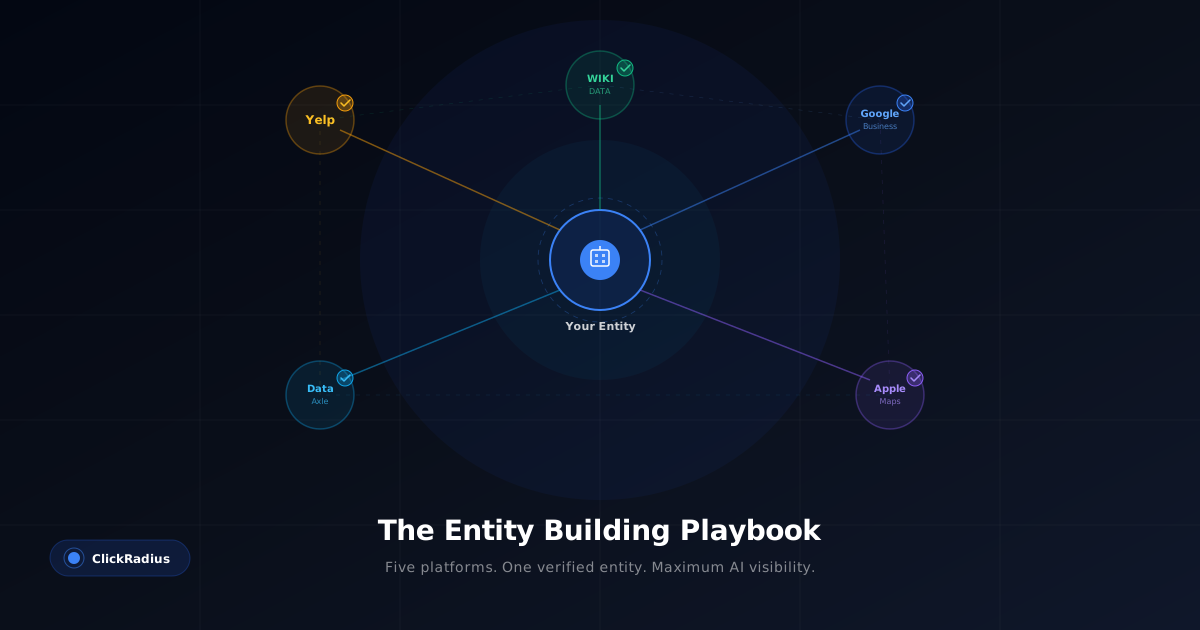
An entity is an identifiable subject: for example, an organization, person, place, product, or service. Public pages can describe that subject with names, identifiers, locations, relationships, and dated facts. The website is one source; profiles, directories, knowledge bases, reviews, and independent publications are other sources with different owners and correction rules.
No reviewed evidence establishes that every answer engine checks one mandatory set of five platforms or assigns a fixed citation lift to a listing. The defensible workflow is to inventory the records that actually apply to the business, determine who controls each field, reconcile material conflicts, and retain later answer observations separately.
What “Entity” Means in AI Search
A page and an entity answer different questions. A page has a URL and content. An organization may be represented by several pages and records. Matching those records requires evidence that the names and identifiers refer to the same subject; a public AI answer does not disclose the complete candidate set, sources checked, matching process, or private weighting.
A local question such as “family dentist in Scottsdale” can produce a map, links, prose, citations, recommendations, or no usable result depending on provider, mode, account, locale, and time. Capture what appeared. Do not infer from that output that every provider used a particular directory or that the business was absent because one record was missing.
Entity consistency is one inspectable input to Generative Engine Optimization (GEO). Weak or conflicting identity evidence can limit what a retriever can resolve, while consistent identity evidence gives later measurement a clearer subject. Neither state establishes or guarantees a citation; any external-engine result must be observed separately.
Surface 1: Wikidata, When the Subject Is Eligible
Wikidata is a community-maintained knowledge base, not a business-listing service. Its current notability policy requires an item to meet at least one stated criterion, including being an identifiable entity describable with serious public references. The community controls acceptance, sourcing, correction, and deletion.
Before proposing an item, check the current policy, existing items, namesakes, source quality, and conflict-of-interest implications. If the subject is not eligible, leave the surface unavailable; do not create promotional markup or treat another directory as a substitute score.
An accepted item proves that the Wikidata record exists under its community rules. It does not prove that an answer provider retrieved it, resolved it to the intended business, assigned it a weight, or will cite the business.
Surface 2: Google Business Profile
For an eligible local business, Google Business Profile is a customer-visible record with owner-supplied fields, Google-managed state, and user-contributed material. Inventory the claimed owner, business name, location or service area, phone, category, hours, website, and the observation date.
Correct facts because customers use them and because Google documents keeping Business Profile information current as an ordinary Search practice. Do not fill every optional field without evidence, treat a completed profile as citation eligibility, or infer how Gemini or another product weighted the record.
A complete-looking profile can still be wrong. Accuracy, ownership, provider acceptance, public display, and appearance in a generated answer are five different questions.
Surface 3: Apple Business Connect and Apple Maps
Where the organization is eligible, Apple Business Connect can provide an authority path for selected place information displayed in Apple products. Record the claimed organization, place identifier, fields submitted, provider response, and later public display separately.
An Apple place record is useful customer-facing evidence. Its existence beside a Google record does not disclose an independent-verification score or establish an advantage in any generated answer.
Surface 4: Data Axle
Data Axle's Local Listings service manages and distributes business data under its own products and partner relationships. Treat the directly observed record, an authorized correction, provider acceptance, and each downstream public listing as separate evidence. A syndication relationship can change and does not prove that every downstream consumer received or used a correction.
Correct only a material inaccuracy supported by current business authority. Never convert “no record found” into a confident absence when the lookup failed, the subject was ambiguous, or the provider does not expose a readable public result.
Surface 5: Yelp
Yelp's business-page guidance describes the fields and responses a claimed-page owner can manage. Keep those authorities separate from provider- and user-controlled content: a business does not control review text, moderation, rating, or whether another provider displays the record.
A captured answer may visibly cite or quote Yelp. That observation establishes the source shown for that request, not a universal Yelp weight, training-data inclusion, future recommendation, or causal effect from review count or sentiment.
Reconcile Meaning, Not Punctuation
Cross-source comparison can find material conflicts, but a text difference is not automatically an error. Preserve the subject, location, department, purpose, effective date, source, and owner before deciding that two values should match.
An entity-record review should ask:
- Identity — Do the records describe the same legal or trading organization, location, practitioner, or department?
- Name — Is the difference a supported alias, punctuation normalization, old name, or genuinely conflicting identity?
- Address and service area — Does each value describe the same location and effective period?
- Phone — Is a different number an error, a tracking line, a department, or a location-specific contact?
- Category and services — Does each provider use the same taxonomy, and does current business evidence support the selected value?
- URL — Do redirects and canonicalization resolve to the intended current public page?
Normalize values for comparison, but change a public record only after proving a real conflict and the authority to correct it. Do not invent a private engine-confidence effect.
The Entity-Schema Connection
The sameAs property in applicable Schema.org markup can point to a stable reference page that unambiguously identifies the same subject. It is an identity declaration, not proof that the publisher controls the linked page or that its facts are accurate.
Add only links whose identity equivalence is supportable. There is no universal five-link requirement. A consumer may ignore the property, and the markup does not prove indexing, entity resolution, ranking, recommendation, or citation.
What ClickRadius Currently Records
ClickRadius reports Off-site Authority and Entity / E-E-A-T as two separate families inside the five-family AI Readiness Score. The disclosed weights are starting estimates, not weights fitted to customer outcomes. Neither family claims to reproduce how an external engine perceives a business.
Our patent-pending technology can prepare eligible sameAs schema that links approved entity profiles. Applying supported markup requires current authorization and a capable connection; otherwise it remains for review or customer implementation. ClickRadius records monthly citation observations across ChatGPT, Gemini, Perplexity, Claude, and Grok; Copilot is not currently supported. External engines decide whether and how to use those entity signals.
The Entity Orchestrator reads selected facts from published site entity markup while preserving higher-authority client-confirmed or CRM facts. Eligible Data Axle, Foursquare, and Bing Places work can enter a reviewable queue; other public-record work may remain a manual checklist. Drafted, queued, provider-accepted, publicly observed, skipped, and failed states remain distinct.
ClickRadius does not claim automatic maintenance across Wikidata, Google Business Profile, Apple Maps, Data Axle, and Yelp. Its monthly answer observations cover ChatGPT, Gemini, Perplexity, Claude, and Grok; Microsoft Copilot is not currently supported. Those answer samples remain separate from entity records and from any site or provider effect.
Run a free AI Readiness analysis to inspect the supported entity and off-site evidence available for a submitted URL. Unavailable evidence remains unavailable, and the result is not a citation forecast. Run a score.