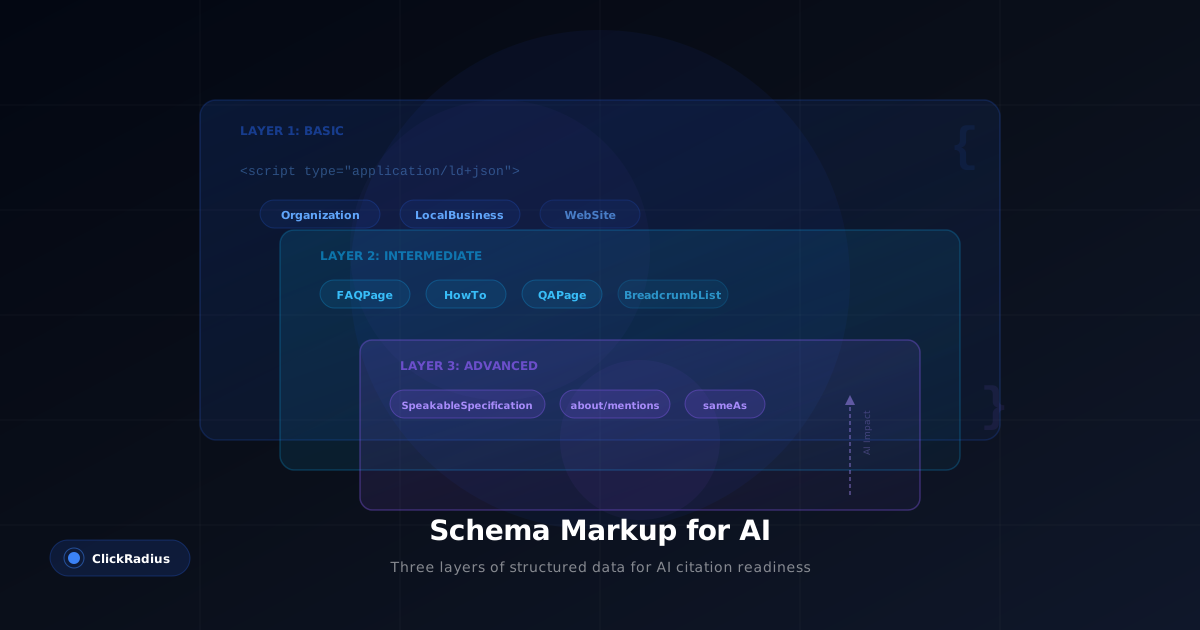
Structured data is a standardized description of a page and the things it represents. A publisher can use Schema.org vocabulary to identify an organization, local business, article, product, breadcrumb trail, or other applicable subject. The markup is a publisher declaration; it is not independent proof that the declared fact is accurate.
A sound implementation answers three separate questions: Is the vocabulary valid for the declared type? Does a named provider currently support a feature that uses it? What did that provider actually display or return after the page was published? Passing one question does not answer the next.
Vocabulary, Provider Eligibility, and Outcomes Are Different
Google Search Central describes structured data as an explicit clue about page meaning and recommends JSON-LD when it is practical. Its general guidelines require markup to represent visible page content and make clear that correct markup does not guarantee a rich result.
For Google AI Overviews and AI Mode, Google's current publisher guidance says ordinary Search eligibility and SEO foundations apply; it does not require a special Schema.org type for those AI features. Other providers may parse or ignore markup under their own changing systems. A public response cannot reveal a universal rule shared by all of them.
A validator can establish syntax and vocabulary compatibility. It cannot establish the truth of a business claim, current feature eligibility at every provider, crawl or index state, selection in an answer, or a business outcome.
Identity and Page Schema
Identity markup should describe the actual subject of the page. Use the most specific applicable type, but do not add a narrower type merely because it sounds more valuable. Required and recommended properties also vary by the provider feature being considered.
Organization and LocalBusiness
Organization, LocalBusiness, and applicable subtypes can express identity and business facts. Include a property only when it is allowed for the chosen type and supported by current authority. An industry template is not evidence of a service list, price range, rating, location, opening hours, or geographic coordinates.
Completeness means supplying the applicable facts a provider documents, not filling every available property. A smaller accurate node is preferable to a larger node containing guesses, stale values, self-asserted ratings, or facts that do not appear on the page.
WebSite and WebPage
WebSite and WebPage can identify the site and page. Add SearchAction only when the described search action actually works. Publication and modification dates should represent real events; regenerating markup is not a new publication date, and changing a timestamp without reviewing the content does not make it current.
Content Schema Must Match Visible Content
Content types describe structures that are already visible. The Schema.org vocabulary and a provider's current search feature list are separate authorities, so the existence of a type does not promise a particular display or AI-answer treatment.
FAQPage
FAQPage describes a page containing one or more questions answered by the publishing organization. The questions and complete answers must be visible and accurate. Google removed its FAQ rich-result documentation in June 2026, as recorded in the Search documentation update log; retaining valid Schema.org markup is not a claim that Google currently displays that retired feature.
QAPage
QAPage is intended for a question with answers supplied by users, such as a community answer surface. It should not be substituted for an editorial page merely because that page contains one question and one publisher-written answer.
A Schema.org type labels visible content. Provider eligibility, retrieval, citation, ranking, and recommendation remain separate observations.
HowTo
HowTo describes a real step-by-step process. Each declared step must correspond to the visible instructions. Google does not list HowTo in its current Search structured-data gallery, so vocabulary validity must not be represented as current Google rich-result support or an AI-citation advantage.
BreadcrumbList
BreadcrumbList can describe a visible navigation path. Its list items should reflect a useful path to the page. Whether a provider displays that path is a provider outcome, not a property of the markup itself.
speakable, about, mentions, and sameAs
These properties have defined meanings, not a shared “advanced AI” tier. Use each only for that meaning and check the documentation of the named consumer before claiming feature eligibility.
SpeakableSpecification
Google's current speakable documentation describes a beta for concise sections of Article or WebPage content used in topical-news text-to-speech playback on supported Google Assistant devices. It is not documented as general permission to cite a page, an AI Overview requirement, or a universal answer-engine signal.
Do not point speakable at an entire sales page or article. A publisher considering the beta should confirm the current country, language, content, type, selector, and provider requirements first.
about and mentions
about identifies a principal subject; mentions identifies another subject referenced by the work. The linked entity must be the one the visible content actually discusses. These declarations can reduce ambiguity for a consumer that supports them, but they do not prove that consumer resolved, retrieved, ranked, or cited the page.
sameAs
The Schema.org sameAs definition points to a reference page that unambiguously identifies the same item. Use a stable URL only when the identity equivalence is supportable. A social profile, directory record, place page, and Wikidata item have different ownership and editorial rules.
sameAs does not verify control of the linked page, certify the facts on it, force two records to merge, or guarantee a provider will crawl, index, retrieve, rank, recommend, or cite the entity. The entity-record audit playbook explains how to keep identity, authority, submission, provider acceptance, and public readback separate.
Common Structured-Data Defects
These defects can be established from the page and the applicable vocabulary or provider policy; none requires a claim about a hidden AI confidence score.
- Hidden or mismatched claims — The markup describes facts or content that a reader cannot find on the page.
- Wrong type or property domain — A property is attached to a type for which the vocabulary does not define it.
- Template facts presented as business facts — A category template invents services, FAQs, prices, ratings, hours, or locations that no current authority confirmed.
- Identity links without identity proof —
sameAspoints to a related page, a namesake, or an account that does not unambiguously identify the represented entity. - Timestamp substitution — A generation time is published as
datePublished, ordateModifiedchanges without a substantive review. - State collapse — Generated markup is reported as deployed, provider acceptance is reported as public readback, or a valid node is reported as a citation outcome.
How ClickRadius Handles Structured Data
The ClickRadius analyzer records observable structured-data findings as one input to the Schema Engine readiness family. That family is 18% of the five-family AI Readiness estimate. Its weight is a starting estimate, not a weight fitted to customer outcomes, and it does not predict citation.
A valid node is a machine-readable declaration. It is not independent fact verification, provider eligibility, deployment proof, or an external-engine result.
The current governed homepage generator prepares one applicable, fact-authorized business node for a generation request. It omits unconfirmed template services, FAQs, breadcrumbs, ratings, and other unsupported assertions, and a vocabulary gate withholds out-of-domain properties. The result enters a generated draft state; generation does not publish it.
Applying an eligible exact schema revision requires current authorization and a connection proven capable of that effect. Otherwise it remains for review or customer implementation. A provider receipt and an independent public-origin reread are recorded separately. A JavaScript-snippet delivery is client-side and cannot be promoted to a successful raw-origin verification.
Additional page types require their own visible content, fact authority, current provider requirements, and delivery evidence. ClickRadius does not claim that every site needs a universal schema package or that every Schema.org type has an executable deployment path.
ClickRadius records monthly answer and citation observations from ChatGPT, Gemini, Perplexity, Claude and Grok; Microsoft Copilot is not currently supported. Comparing observations before and after a schema change can identify a correlation worth investigating, but it does not establish that schema caused the change. Schema Engine is one of five AI Readiness evidence families, whose starting weights have not been fitted to customer outcomes.
Run a free AI Readiness analysis to inspect the structured-data evidence available at a submitted URL. The result is a readiness estimate, not a provider eligibility decision or citation forecast. Run a score.