The Measurement Problem
ROI is attributable net return compared with an identified investment over a defined scope and period. It is not a synonym for work completed, a readiness score, a sampled citation, or modeled opportunity. AI answers may or may not produce a trackable visit, so a missing referral must remain unknown unless another retained record supplies attribution.
A defensible report can still say a great deal. It can prove which exact revision was authorized, what a provider accepted, what an independent public-origin reread observed, which setup evidence the analyzer measured, what configured AI providers returned for tested prompts, and which leads or revenue records carry a declared source. What it cannot do is turn sequence or correlation into causation.
The Evidence Classes That Matter
1. Governed delivery
Record the approved exact revision, current authority, capable connection, provider response, public-origin reread where supported, and correction or withdrawal path. Provider acceptance is not proof of a public effect, and a prepared recommendation is not a deployed change.
2. AI Readiness
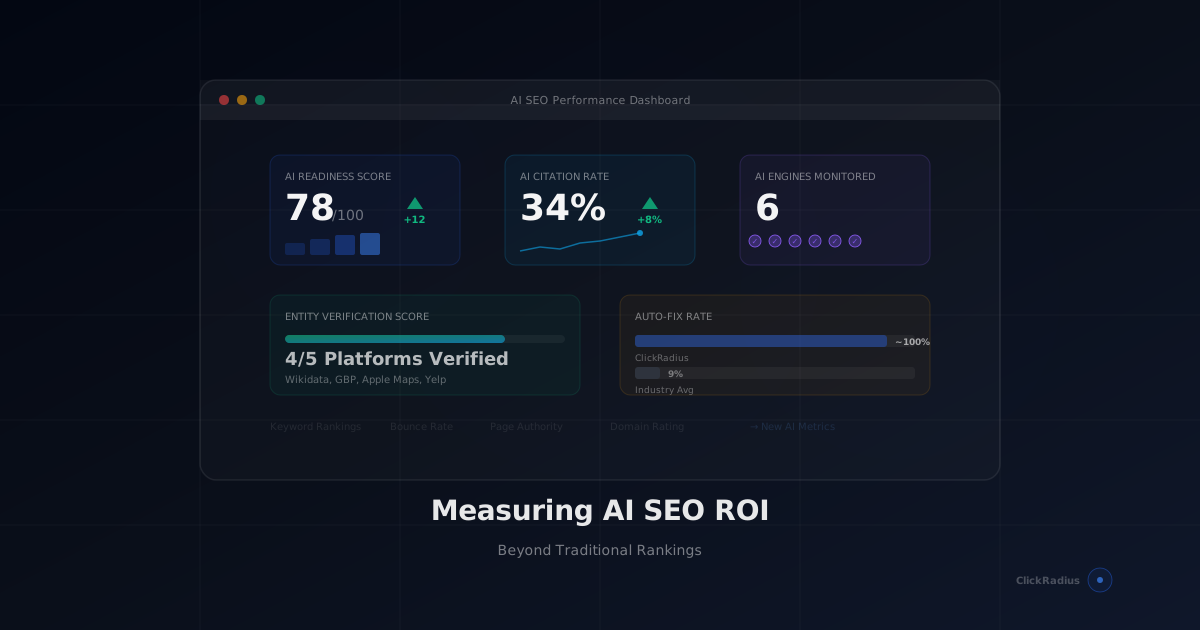
The AI Readiness Score estimates five weighted setup-evidence families: Off-site Authority (28%), On-page GEO (26%), Schema Engine (18%), Entity / E-E-A-T (18%), and Crawler Access (10%). These are starting estimates, not weights fitted to customer outcomes. SEO Health is separate. When supported evidence does not clear the versioned coverage threshold, Readiness remains unavailable instead of converting missing evidence to zero.
3. AI Presence
AI Presence separately summarizes monthly sampled answers from ChatGPT, Gemini, Perplexity, Claude, and Grok. Report each engine, tested prompt set, successful sample count, mentions, citations, and unknown or failed observations. Microsoft Copilot is not currently supported. A sample describes those observations; it is not a census of every answer users saw and does not identify why an answer changed.
4. Business outcomes
Track AI-domain referral sessions, campaign identifiers, optional intake answers, qualified leads, booked revenue, cost, and margin with their actual provenance. A self-reported source is evidence of what that respondent said. A rise in direct traffic or branded search beside a citation change is correlation, not attribution by itself.
These classes belong on the same dashboard only when they remain visibly separate. A score increase does not predict a citation; a sampled citation does not prove a lead; and a lead recorded later does not, by sequence alone, prove which piece of work caused it.
How to Track ROI
Start with a named organization, a defined period, and the costs included in the investment. Keep observed facts apart from modeled scenarios. A change log can prove that work was authorized and delivered; a readiness result can describe supported setup evidence; an AI Presence report can describe a fixed set of monthly samples. None of those records is revenue.
Retain Comparable Observations
For AI Presence, retain the tested prompt set, provider, model or endpoint when available, observation date, successful-response denominator, mentions, citations, and unknown or failed samples. Compare like with like and label any query-set or provider change. Moving from 5 mentions in 100 successful samples to 25 in 100 is an observed change in that sample frame; it is not proof of a fivefold change in the entire market.
Attribute Outcomes at the Record Level
Preserve referral domains, campaign identifiers, landing pages, call records, optional intake answers, CRM source fields, qualified leads, booked revenue, cost, and margin. Use only the outcomes whose provenance supports the attribution being claimed. If a lead has no defensible source, classify its AI contribution as unknown rather than assigning it from timing.
Correlation can identify a question worth investigating. It cannot, by itself, identify which work or engine answer caused a lead.
Keep Scenarios Labeled as Scenarios
A planning model may combine assumptions about observed presence, response behavior, conversion, margin, and cost. Show every assumption and a range of outcomes. Do not relabel the model as measured ROI. When attributable net return is known, state the exact ROI formula and included costs; when it is not known, report the evidence that is available and leave ROI unresolved.
Compare Costs Without Assuming Free Results
Paid media and AI-search work have different cost structures, measurement limits, and control surfaces. Compare them using actual spend, labor, provider costs, attributed outcomes, and uncertainty. An unpaid appearance in a sampled answer does not establish zero marginal cost, permanence, future recommendation, or compounding return.
The Attribution Challenge
An AI answer can include a source link, but a later phone call, direct visit, walk-in, or branded search may carry no machine-readable trail back to that answer. Even a referral identifies a preceding visit, not necessarily the sole cause of a purchase. The defensible response is not to distribute unattributed outcomes across nearby observations.
Report known referral and campaign evidence, preserve optional self-reported discovery answers as self-report, and show unattributed outcomes separately. Aggregate movement can be displayed beside AI Presence, but it must be labeled as correlation. If a controlled test or another credible design supports a stronger inference, document that design and its limitations.
Provider interfaces and referral behavior can change. Treat richer attribution as future evidence only after it exists and is retained; do not assume that a platform will add it or that every user journey will become observable.
Why Early Measurement Matters
A baseline makes later observations interpretable when its scope is retained. Save the page or organization measured, scoring version, evidence coverage, prompt set, supported engines, successful-response denominator, and date. Without that context, two percentages or scores may not be comparable.
History can reveal changes in the retained samples and records. It does not make adoption inevitable, prove that an optimization worked, or guarantee a durable advantage. Its value is narrower and more useful: reviewers can see what was measured, what changed, what remained unknown, and whether a proposed decision is supported by the available evidence.
How ClickRadius Provides These Metrics
ClickRadius keeps the relevant surfaces distinct:
- AI Readiness — a versioned 0-100 setup-evidence estimate across the five disclosed families when evidence coverage is sufficient; otherwise unavailable.
- SEO Health — a separate technical-search measure, never blended into AI Readiness.
- AI Presence — monthly sampled observations for ChatGPT, Gemini, Perplexity, Claude, and Grok, with per-engine denominators and unknown states. Microsoft Copilot is not currently supported.
- Governed work — records that distinguish a prepared change, owner authorization, provider receipt, independent public-origin reread where supported, and correction or withdrawal.
These records supplement rather than replace analytics, CRM, call, cost, and revenue evidence. External engines control crawling, indexing, ranking, recommendation, and citation. ClickRadius can measure supported evidence, prepare governed work, record receipts, and observe configured samples; it cannot guarantee traffic, revenue, recommendation, or citation.
Run the free AI Readiness analysis for a submitted URL. It reports the five setup-evidence families when coverage is sufficient and does not measure current citation or contact an AI engine.